

Filing your corporate tax in the UAE return is a mandatory annual obligation for every registered business. 2026 is the year most companies will file their second return, which means the FTA already has your first submission as a benchmark. Accuracy matters more than ever.
This guide walks you through the entire process on the FTA’s EmaraTax portal: preparation, document gathering, taxable income calculation, form submission, and payment. Whether you are filing for the first time or refining your process from last year, you will find the exact steps, required documents, key calculations, and the most common mistakes that trigger penalties or FTA queries.
Updated for 2026 with the latest FTA guidance, the reformed penalty framework under Cabinet Decision No. 129 of 2025, and the CTP006 penalty waiver initiative.
On This Page
Who Must File a Corporate Tax Return in the UAE?
Every taxable person must file. There are no exceptions. This includes mainland companies (LLCs, joint-stock, partnerships), Free Zone entities (including QFZPs with the 0% rate, where filing is what maintains your eligibility), non-residents with a Permanent Establishment or nexus in the UAE, and natural persons with business turnover above AED 1 million.
Filing is mandatory even if your taxable income is below AED 375,000 and falls entirely within the 0% bracket. It is mandatory if you are claiming Small Business Relief. It is mandatory if your business had zero income during the tax period. A NIL return must still be submitted. There is no minimum income threshold that exempts you from the filing obligation.
Before you can file, you need a Tax Registration Number. If you have not registered yet, complete your corporate tax registration first. Without a TRN, you cannot access the filing section of EmaraTax.
Returns must be filed within nine months from the end of your financial year. One return per tax period. No advance or provisional returns exist under UAE CT law. For the full calendar of 2026 deadlines, see our guide on UAE corporate tax deadlines.
How to File Corporate Tax on EmaraTax: Step-by-Step
Step 1: Log In to EmaraTax
Go to the EmaraTax Portal and sign in using your registered email and password, or authenticate via UAE Pass. If you do not have a UAE Pass account, download the app and register using your Emirates ID. Once logged in, navigate to the “Corporate Tax” section on the left menu of your dashboard.
Step 2: Access Your Filing Window
Under “Required Actions,” look for the Corporate Tax Return Submission option. If this action is not visible, your tax period may not have ended yet. Check your tax period dates in your Corporate Tax Registration record to confirm. Click the action to begin.
Step 3: Confirm Your Tax Period and Entity Details
The system displays your entity name, licence number, tax period dates, and financial year-end. Verify that everything is correct before proceeding. If any details are wrong, you must amend your tax record with the FTA before you can file. Changes to entity details must be reported within 20 business days of any modification. Filing with incorrect entity information creates discrepancies that the FTA will flag.
Step 4: Enter Revenue and Financial Data
This is where the substance of your return lives. Input your financial results for the tax period:
- Total revenue from all sources, including foreign income for resident persons.
- Total deductible expenses: operational costs, depreciation, R&D, and interest (subject to limitations under the CT Law).
- Exempt income: qualifying dividends, capital gains on qualifying shareholdings, and income from qualifying Free Zone activities.
- Adjustments: add back non-deductible items such as government fines, penalties, entertainment costs exceeding limits, and donations to non-qualifying entities.
- Elections: Small Business Relief, transfer pricing adjustments, and tax loss relief carried forward from prior periods.
Every figure you enter must match your financial statements exactly. The FTA treats your submission as a self-assessment declaration. If the numbers do not match your books, you will need to explain why.
Step 5: Calculate Taxable Income and Tax Payable
EmaraTax calculates taxable income based on your inputs. Before you accept the calculation, verify it independently:
- AED 0 to 375,000: taxed at 0%.
- Above AED 375,000: taxed at 9%.
Apply any Foreign Tax Credits for taxes paid abroad on the same income. Deduct any Tax Loss Relief from prior periods, up to 75% of the current period taxable income.
Step 6: Upload Supporting Documents
Attach all required documents to the corresponding sections of the return (see the full document checklist below). Files should be in PDF format, legible, and consistent with the figures entered in the form. Uploading incomplete or mismatched documentation is one of the most common reasons the FTA raises queries after submission.
Step 7: Review, Declare, and Submit
Review every field. Once submitted, your return is treated as a formal self-assessment. Errors discovered later may require a Voluntary Disclosure and could trigger penalties. Tick the declaration checkbox confirming accuracy, then submit.
Step 8: Pay Any Corporate Tax Due
If your return shows a payable amount, make a payment through EmaraTax before the filing deadline. Payment and filing share the same deadline. Submitting without paying, or paying without filing, both count as non-compliance. The FTA has repeatedly warned that bank transfers may take days to process. Payment is only received when it reaches the FTA, not when you initiate the transfer. Do not leave payment to the last day.
If you would rather have professionals handle this process end-to-end, our corporate tax filing services cover everything from financial statement preparation through to EmaraTax submission and payment.
Pro tip: Filing before the 7-month mark (instead of waiting for the full 9 months) qualifies you for the AED 10,000 late registration penalty waiver under the CTP006 initiative, if applicable to your situation.
Documents You Need Before Filing Your Corporate Tax Return
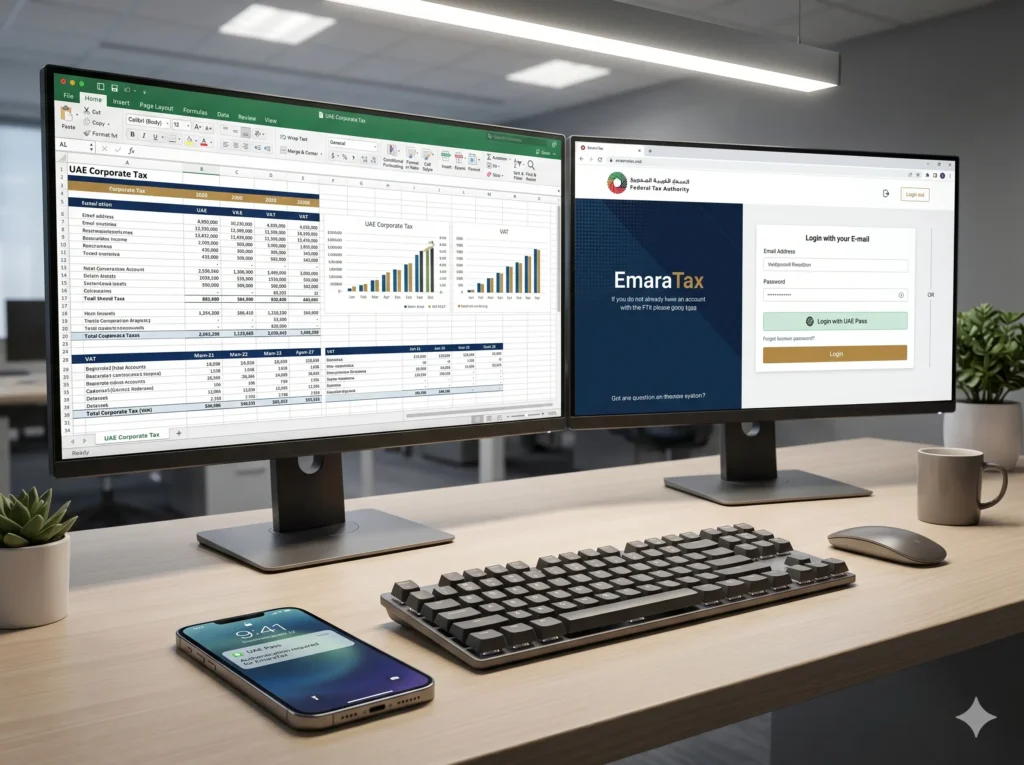
At minimum, you need finalized financial statements (income statement, balance sheet, cash flow), your TRN, a general ledger with bank reconciliations, and supporting documentation for every deduction you plan to claim. If your revenue exceeds AED 50 million or you hold QFZP status, you also need audited financials. And if you have related-party transactions, transfer pricing documentation (Master File and Local File) must be ready before you open EmaraTax.
The FTA will cross-reference your return against WPS payroll records, your invoices, and your accounting data, so every number needs a document behind it.
Financial Records (Mandatory for All Filers)
- Finalized financial statements: income statement, balance sheet, and cash flow statement.
- General ledger, trial balance, and bank reconciliations: the accounting data that supports every figure in the return.
- Chart of accounts: aligned with IFRS standards and structured for CT computation.
Tax-Specific Documentation
- TRN and Corporate Tax Registration Certificate.
- Supporting invoices, receipts, and contracts for all deductions claimed.
- Depreciation schedules for fixed assets.
- Related-party contracts and invoices, plus transfer pricing documentation (Master File and Local File for Connected Persons).
- Election documentation: Small Business Relief, Tax Loss Relief, Free Zone corporate tax qualifying income classification.
- Proof of foreign tax paid if claiming Foreign Tax Credit.
Audited Financial Statements (Mandatory If)
Revenue exceeds AED 50 million, or the entity holds Qualifying Free Zone Person status, or the entity is part of a Tax Group. Audits must be performed by an MOE-licensed firm. Our audit services team coordinates audit timelines with your CT filing deadline to ensure both are completed on time.
WPS Payroll Records
The FTA cross-references salary expenses against Wage Protection System data. If your payroll costs on the return do not match WPS records, the FTA will query the discrepancy. Ensure payroll figures are reconciled before filing.
Professional accounting services in the UAE ensure your records are IFRS-compliant and structured to support accurate CT calculations before you reach the filing stage. The quality of your books determines the quality of your return.
Key Calculations and Elections in Your Corporate Tax Return
| Concept | Description |
|---|---|
| Taxable Income Calculation |
Start with your accounting income per financial statements. Add back non-deductible expenses: government fines, penalties, donations to non-qualifying entities, and 50% of entertainment costs above the applicable threshold. Subtract exempt income: qualifying dividends, capital gains on qualifying shareholdings. Apply any transfer pricing adjustments for related-party transactions under the arm's-length principle. The result is your taxable income.
For businesses with intercompany transactions, transfer pricing documentation must support the arm's-length pricing applied. Missing documentation can result in AED 20,000 penalties, increasing for repeated violations. |
| Small Business Relief Election | If your revenue is AED 3 million or less for the relevant tax period, you can elect Small Business Relief on your return. This is not automatic. You must actively select it on the form. If you qualify but forget to elect, you will be assessed at standard rates. You cannot be a QFZP, a Tax Group member, or a member of a multinational enterprise group to qualify. Losses cannot be carried forward from an SBR period. |
| Tax Loss Relief | Losses from prior tax periods can be carried forward and offset against up to 75% of taxable income in the current period. Losses cannot be carried back. They must be properly documented and reported on the return. If you did not declare losses in the period they occurred, you may not be able to claim them later. |
| Free Zone Person Filing Considerations | QFZPs must separately report qualifying income (taxed at 0%) and non-qualifying income (taxed at 9%). Failure to meet substance requirements or the de minimis threshold can result in loss of QFZP status for five consecutive tax periods. That is not a one-year correction. It is a five-year penalty. Detailed eligibility conditions are covered in our Free Zone corporate tax guide. |
| Foreign Tax Credit | Taxes paid abroad on income that is also taxable in the UAE can be credited against your UAE corporate tax liability. The credit is limited to the UAE tax payable on that same income. You cannot credit more foreign tax than the UAE tax you owe on the relevant income. Supporting documentation from the foreign jurisdiction is required. |
7 Common Corporate Tax Filing Mistakes UAE Businesses Make
When to Start Preparing Your Corporate Tax Return
Filing Your Corporate Tax Return Does Not Have to Be Stressful
Frequently Asked Questions About Filing Corporate Tax in the UAE
How do I file corporate tax in the UAE?
Through the FTA’s EmaraTax portal. Log in with UAE Pass or registered credentials, navigate to Corporate Tax, complete the return form with your financial data, upload supporting documents, and submit. Payment must also be made through EmaraTax before the filing deadline.
What is the deadline to file a corporate tax return?
Nine months from the end of your financial year. For businesses with a December year-end (31 Dec 2025), the deadline is 30 September 2026. See our full UAE corporate tax deadlines 2026 calendar for other financial year-ends.
Do I need to file if my income is below AED 375,000?
Yes. Filing is mandatory for all taxable persons regardless of income level. Even businesses in the 0% bracket must submit a return. Failing to file incurs penalties of AED 500 per month from the first day past the deadline.
What happens if I file late?
Late filing triggers AED 500 per month for the first 12 months, increasing to AED 1,000 per month after that. Late payment incurs 14% annual interest on the outstanding amount. Both penalties accrue independently. Filing without paying, or paying without filing, is treated as a separate violation.
Do I need audited financial statements to file?
Yes. Filing is mandatory for all taxable persons regardless of income level. Even businesses in the 0% bracket must submit a return. Failing to file incurs penalties of AED 500 per month from the first day past the deadline.
Can I file a NIL corporate tax return?
Is corporate tax filing different from VAT filing?
Can AH Chartered Accountants file my corporate tax return?
Ameer Hamza
Ameer Hamza (ACCA) is the Managing Partner at AH Chartered Accountants. With 7+ years of expertise advising over 50 UAE businesses, he specialises in statutory audits, corporate tax strategy, and corporate financial modelling.
Ameer authors our technical content to ensure business leaders receive precise, FTA-compliant guidance directly from an active industry expert.
Learn more about Ameer Hamza and AH Chartered Accountants on our About Us page.
50+
25+
7+

Related Services
UAE Corporate Tax Services
Explore CT filing →UAE Corporate Tax Registration
Explore VAT Services→UAE Corporate Tax Filing
Explore CT Registration→Book a Consultation
Address
Phone
+971 50 548 0159