
What is a Tax Residency Certificate in the UAE?
A UAE Tax Residency Certificate (TRC), issued by the Federal Tax Authority under Cabinet Decision No. 85 of 2022, is an official document confirming that an individual or company is a UAE tax resident for a specific 12-month period. It is required to claim Double Taxation Avoidance Agreement benefits and reduce foreign withholding taxes. Applications are submitted through the EmaraTax portal.
Key Data: UAE Tax Residency Certificate
| Topic | Key Data | Source |
|---|---|---|
| Governing legislation | Cabinet Decision No. 85 of 2022 (effective 1 March 2023) | mof.gov.ae |
| Implementation rules (natural persons) | Ministerial Decision No. 27 of 2023 (effective 1 March 2023) | mof.gov.ae |
| Issuance rules (DTA purposes) | Ministerial Decision No. 247 of 2023 (issued 16 October 2023) | mof.gov.ae |
| Procedural guide | FTA Tax Procedures Guide TPGTR1 (18 October 2024) | tax.gov.ae |
| Resident Person definition (Corporate Tax) | Federal Decree-Law No. 47 of 2022, Article 11 | tax.gov.ae |
| Validity period | 12 months (specific dates stated in certificate) | FTA |
| Renewal | No auto-renewal; fresh application required each year | FTA |
| Submission fee | AED 50 (non-refundable, paid at application) | FTA Service Card |
| Issuance fee: CT registrant (TRN) | AED 500 | FTA Service Card |
| Issuance fee: Natural person without CT TRN | AED 1,000 | FTA Service Card |
| Issuance fee: Juridical person without CT TRN | AED 1,750 | FTA Service Card |
| Hard copy (per copy, optional) | AED 250 | FTA Service Card |
| Typical processing time | 5 business days (after document approval) | FTA |
| Earliest application: Juridical | 3 months after start of tax period | FTA Guide TPGTR1 |
| Earliest application: Natural person | As soon as residency criteria are met | FTA Guide TPGTR1 |
| Earliest application: Government entity | 1 day after start of tax period | FTA Guide TPGTR1 |
| Minimum company age for TRC | 12 months from incorporation | FTA Guide TPGTR1 |
| UAE DTA network | 137 Double Taxation Agreements concluded | mof.gov.ae |
Table of Contents
Who Needs a UAE Tax Residency Certificate, and When?

Any individual or company that earns income subject to taxation in another country, and wants to claim treaty benefits to avoid being taxed twice, needs a UAE Tax Residency Certificate. The TRC is also required for banking, immigration, and regulatory purposes where foreign authorities request formal proof of UAE tax residency.
The most common scenarios where a TRC becomes necessary:
- Founder receiving dividends from a foreign subsidiary: A TRC under the relevant DTAA can reduce or eliminate the foreign withholding tax on those dividends.
- UAE holding company with shareholders in a treaty country: Required when distributing profits to access reduced withholding rates.
- Expatriate with rental income or business profits abroad: The TRC supports DTAA claims to prevent the foreign jurisdiction from taxing income the UAE has already considered.
- Mid-market company with cross-border invoicing: Foreign clients may request the TRC to apply the correct withholding treatment.
- Free Zone business with international clients: Despite the 0% rate available to a Qualifying Free Zone Person, a TRC may still be required by the foreign jurisdiction to release withholding tax relief.
- Foreign tax authority or banking compliance: When a non-UAE tax authority questions residency, or an international bank requests CRS or FATCA documentation, the TRC is the primary documentary defence.
In our work with cross-border clients since the FTA updated the TRC procedure in October 2024, the most common trigger is a foreign authority or banking partner requesting residency evidence with a hard deadline. Planning the application proactively is the difference between a clean approval and a delayed transaction.
UAE Tax Residency Eligibility: Individuals vs Companies

Cabinet Decision No. 85 of 2022 sets out three eligibility paths for individuals and a substance test for companies.
Individuals: The 3 Eligibility Tests
| Test | Physical Presence | Additional Conditions | Use Case |
|---|---|---|---|
| Standard Test (183-day rule) | 183 days or more in any 12-month period | None beyond presence | Accepted for both DTAA and domestic purposes |
| Enhanced Test (90-day rule) | 90 to 182 days in any 12-month period | UAE citizen, GCC national, or holder of a valid UAE residence permit; AND has a permanent place of residence in the UAE; AND carries on employment or business in the UAE | Accepted for both DTAA and domestic purposes |
| Centre-of-Life Test | Less than 90 days | UAE is the individual's primary place of residence AND the centre of their financial and personal interests | Generally accepted for domestic purposes only; foreign authorities may not accept under DTAA |
All three tests are set out in Article 4 of Cabinet Decision No. 85 of 2022, with implementation details in Ministerial Decision No. 27 of 2023. Days are counted as any day or part of a day physically present in the UAE; they do not need to be consecutive. Days spent in the UAE due to exceptional circumstances may be disregarded.
Companies: The Substance Test
A company is considered a UAE tax resident if it is either incorporated in the UAE or effectively managed and controlled from the UAE. Mere incorporation alone is not always sufficient. The Federal Tax Authority assesses substance, not just registration.
The legal basis is Federal Decree-Law No. 47 of 2022, Article 11, read together with Cabinet Decision No. 85 of 2022. The FTA evaluates four substance indicators:
- Physical office or registered premises in the UAE.
- Employees or senior management based in the UAE.
- Strategic and commercial decisions made in the UAE (board meetings, board minutes).
- Local bank accounts, active contracts, and accounting records maintained in the UAE.
Free Zone companies, mainland companies, and holding companies all qualify in principle. What matters is operational substance.
Offshore companies cannot obtain a TRC. They lack the physical and economic presence required by the test, regardless of incorporation status.
Newly incorporated companies must have existed for at least 12 months before applying. This rule is set out in the FTA Service Card and confirmed in Guide TPGTR1.
Companies often assume a UAE trade licence alone qualifies them for a TRC. In practice, the FTA’s review focuses on substance evidence: board decisions made in the UAE, employees on UAE payroll, and active operational presence. Weak substance is the leading cause of TRC rejections for juridical persons. Completing Corporate Tax registration first also unlocks the reduced AED 500 issuance fee.
Required Documents for a UAE TRC Application

The Federal Tax Authority simplified the TRC documentation requirements in October 2024. Bank statements are no longer mandatory for natural persons under DTAA applications, and audited financial statements are no longer required by default for companies applying during their current tax period. The exact documents depend on the applicant type and the residency test that applies.
This change followed the FTA’s release of Tax Procedures Guide TPGTR1 on 18 October 2024. Any advisor still listing those documents as universal requirements is working from outdated pre-2024 guidance.
Documents for Individuals (Natural Persons)
Table 1: 183-Day Test (under DTAA)
| Document | Required |
|---|---|
| Emirates ID and UAE residence visa, OR passport with entry-exit report | Yes |
| Salary certificate or proof of source of income | Yes |
| Bank statements | No (no longer required since October 2024) |
Table 2: 90-Day Test (Enhanced)
| Document | Required |
|---|---|
| All documents from the 183-day test above | Yes |
| Proof of employment or business activity in the UAE | Yes |
| Proof of permanent place of residence (title deed, Ejari, or long-term rental contract) | Yes |
Table 3: Centre-of-Life Test (under 90 days, domestic purposes)
| Document | Required |
|---|---|
| All documents from the 183-day test above | Yes |
| Proof of financial interest in the UAE (UAE-based assets, investments, source of income) | Yes |
| Proof of personal interest in the UAE (family, social, cultural ties) | Yes |
| Proof of primary place of residence | Yes |
Documents for Companies (Juridical Persons)
For companies, the FTA focuses on four document categories: legal existence, effective management, economic presence, and tax registration status.
| Category | Documents |
|---|---|
| Legal existence | Trade licence, Certificate of Incorporation, Memorandum of Association (MOA) |
| Effective management | Board resolutions or minutes showing decision-making in the UAE; organisational chart highlighting UAE-based management; power of attorney or management agreements if applicable |
| Economic presence | Office lease or Ejari; UAE bank account statements; active contracts or invoices supporting local operations |
| Tax registration | UAE Corporate Tax registration number (TRN) and proof of authorised signatory |
| Older companies (if FTA requests) | Audited financial statements for the relevant period |
Audited financial statements are no longer a default requirement for companies applying during their current tax period. They may be requested case-by-case, particularly for older companies or where the application covers a completed tax period. This change followed the October 2024 procedure update.
How to Apply for a UAE TRC: Step-by-Step Process
TRC applications are submitted online through the EmaraTax portal managed by the Federal Tax Authority. The process is fully digital, and processing typically takes around five business days once all documents have been accepted. The application is governed by Ministerial Decision No. 247 of 2023 for treaty-purpose certificates and by Cabinet Decision No. 85 of 2022 for domestic-purpose certificates.
Step 1: Create or access an EmaraTax account
Either create a new EmaraTax profile or log in to an existing one. Companies must link their account to their trade licence and authorised signatory.
- Estimated time: 15-30 minutes (initial setup)
- What you provide: Trade licence (for companies), Emirates ID and passport (for individuals)
Step 2: Select the Tax Residency Certificate service
From the dashboard, go to “Other Services” and choose “Tax Residency Certificate.” Select your applicant type: Natural Person, Legal Person, or Legal Person – Government.
- Estimated time: 2 minutes
Step 3: Define the certificate purpose and tax period
Choose between “Double Tax Treaty Purposes” or “Domestic Purposes.” Then select the 12-month period the certificate will cover. A TRC cannot be issued for a future period. If you have a Corporate Tax registration number, linking it at this step reduces the issuance fee from AED 1,000 or AED 1,750 down to AED 500.
- Estimated time: 5 minutes
- Critical decision: Selecting the wrong purpose (e.g. “domestic” when you need “DTAA”) issues a certificate that foreign authorities will not accept for treaty claims.
Step 4: Upload supporting documents and pay fees
Upload the documents matching your applicant type and residency test. The submission fee is paid at application; the issuance fee is paid after preliminary approval and must be settled within 30 business days or the application is cancelled.
- Fees: AED 50 (submission) + AED 500 to AED 1,750 (issuance, depending on tax registration status) + AED 250 per hard copy if required
Step 5: Submit, track, and download the certificate
Submit the application and track status through the portal. Once approved, the digital TRC is issued by email and downloadable from EmaraTax. Request a hard copy through the portal if a foreign authority requires physical documentation.
- Processing time: 5 business days typical
- What you receive: Digital PDF certificate with QR code, valid for the stated 12-month period
DTAA TRC vs Domestic TRC: Which One Do You Need?

The EmaraTax portal issues two types of Tax Residency Certificates, and choosing the wrong type is one of the most common reasons applications fail to deliver their intended purpose. The right choice depends on whether you are claiming benefits under a tax treaty or proving residency for purposes unrelated to a treaty.
| Question | Answer | Certificate Type |
|---|---|---|
| Are you claiming reduced withholding tax in a country that has a tax treaty with the UAE? | Yes | DTAA TRC: required for treaty benefit claims |
| Is the foreign country one of the 137 UAE treaty partners? | Yes | DTAA TRC |
| Are you opening a bank account abroad and need to prove UAE tax residency without claiming treaty benefits? | Yes | Domestic TRC is usually sufficient |
| Is the foreign authority requesting evidence under CRS or FATCA without a treaty context? | Yes | Domestic TRC |
| Are you from a country without a UAE tax treaty (e.g. United States)? | Yes | Domestic TRC (foreign authorities will not accept a DTAA TRC where no treaty exists) |
| Is the certificate based on the under-90-day Centre-of-Life Test? | Yes | Only accepted for Domestic TRC; foreign authorities under DTAA generally require the 90-day or 183-day tests |
If you are unsure which certificate applies, confirm with the foreign tax authority or treaty advisor before applying. Issuing the wrong type means paying the FTA fees twice; the certificate is not interchangeable, and a fresh application is required to correct the type.
6 Common Mistakes That Cause TRC Rejections (and How to Avoid Them)
The Federal Tax Authority rejects TRC applications most often for preventable reasons. Six recurring issues account for the majority of rejections we see in client work.
Mistake 1: Selecting the Wrong Certificate Purpose
Choosing “Domestic Purposes” when you actually need a DTAA TRC is the most common error. The two certificates are not interchangeable. If the foreign authority requires a DTAA certificate to release reduced withholding rates, a domestic-purpose TRC will be rejected, and you will need to submit a fresh application with new fees. Confirm the purpose with the foreign authority or treaty advisor before applying.
Mistake 2: Applying Too Early (or for a Future Period)
The TRC cannot be issued for a tax period that has not yet started. For companies, the earliest application date is three months after the start of the tax period. For individuals, the residency criteria must already be met before applying. Newly incorporated companies cannot apply until they have existed for at least 12 months. Applying earlier leads to automatic rejection.
Mistake 3: Weak Substance Evidence for Companies
Holding a UAE trade licence does not automatically prove tax residency. The FTA assesses substance: physical office, UAE-based management, board decisions made locally, employees on UAE payroll, active bank accounts and operations. Companies whose management or shareholders are largely outside the UAE face stricter scrutiny, particularly for DTAA TRC applications. This is also where TRC differs from Corporate Tax exemptions: exemption status focuses on what the entity is, while TRC eligibility focuses on where decisions and operations actually happen.
Mistake 4: Inconsistent or Outdated Documentation
Mismatches between the trade licence, management address, bank account location, and financial statements raise red flags. A board resolution showing decisions made outside the UAE while the application claims UAE-based management will cause a rejection. Professional accounting and bookkeeping that maintains a consistent audit trail throughout the year is what makes a TRC application defensible. Ensure every document tells the same story.
Mistake 5: Listing Documents the Post-2024 Procedure No Longer Requires
Some advisors still ask clients to gather bank statements for natural person DTAA applications, or audited financials for company applications, during the current tax period. These were removed from the documentation list in the FTA’s October 2024 update. Submitting them does not harm the application, but assuming they are mandatory often delays the process while clients chase paperwork that is no longer required.
Mistake 6: Applying for the Same Period You Have Already Used
Each TRC covers exactly one 12-month period and cannot be reused. If a foreign authority requires evidence for the next tax year, a fresh application is required with updated documents: for individuals, a new entry-exit report; for companies, a renewed trade licence and current financial evidence. There is no auto-renewal. Treat the TRC as an annual compliance task.
TRC vs Tax Domicile Certificate vs Commercial Activities Certificate: What's the Difference?
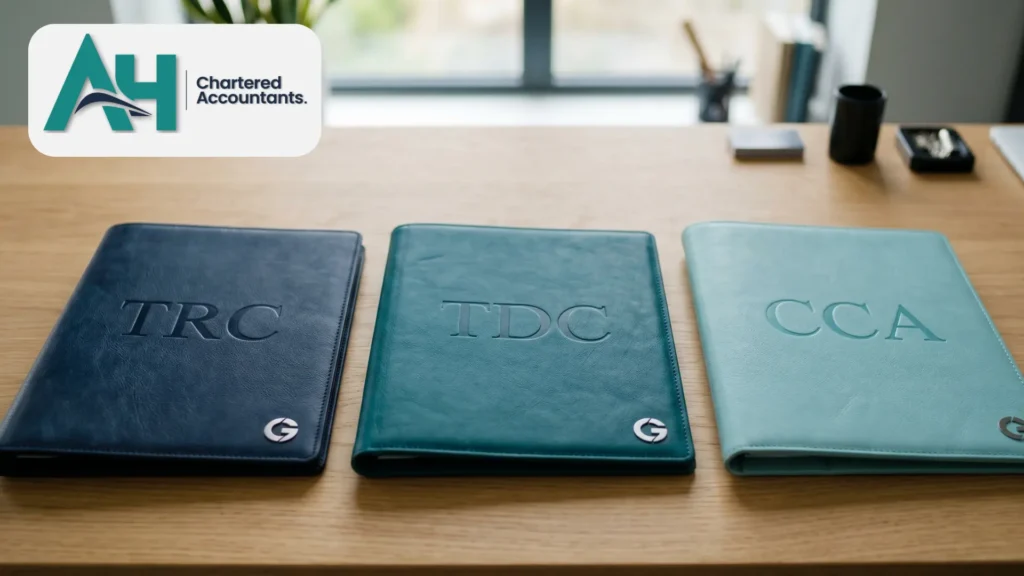
The Federal Tax Authority issues several residency and activity certificates through the EmaraTax portal. The names overlap and the application flow is similar, but each serves a different purpose.
| Certificate | Purpose | Issued By | Common Confusion |
|---|---|---|---|
| Tax Residency Certificate (TRC) | Proof of UAE tax residency for DTAA claims or domestic purposes | FTA via EmaraTax | The standard certificate covered in this guide |
| Tax Domicile Certificate | An older name for the TRC; both terms refer to the same document | FTA | "Tax Domicile" and "Tax Residency" are used interchangeably |
| Commercial Activities Certificate (CCA) | Enables UAE businesses to recover VAT paid in foreign jurisdictions where bilateral agreements exist | FTA via EmaraTax | Often confused with TRC because the portal flow is similar, but the use case is VAT recovery, not income tax |
Need a UAE Tax Residency Certificate for a cross-border transaction or foreign tax Claim?
Our ACCA-qualified team handles UAE TRC applications end-to-end: eligibility assessment, document preparation, EmaraTax submission, and FTA follow-up until issuance. Most applications we file are approved on first review.
Frequently Asked Questions About UAE Tax Residency Certificate
The Federal Tax Authority charges AED 50 for application submission, plus an issuance fee of AED 500 if you are registered for Corporate Tax, AED 1,000 if you are a natural person without a Corporate Tax TRN, or AED 1,750 if you are a juridical person without a Corporate Tax TRN. Hard copies cost AED 250 each. All fees are non-refundable.
Once all required documents have been submitted and accepted, the FTA typically issues the TRC within five business days. The total elapsed time, including document preparation and any FTA queries, is usually two to three weeks for a straightforward application. Complex cases, particularly where substance evidence requires clarification, can take longer.
Yes. Free Zone companies, including Qualifying Free Zone Persons, are eligible for a UAE TRC provided they meet the substance test: physical presence, effective management, and operational activity in the UAE. Free Zone incorporation alone is not enough. The TRC application is the same as for mainland companies.
No. Offshore companies (such as those incorporated in offshore jurisdictions without local UAE presence) cannot obtain a TRC. They fail the substance test because they have no physical office, employees, or operational activity in the UAE. The TRC is only issued to entities with genuine UAE tax residency under Article 11 of Federal Decree-Law No. 47 of 2022, read with Cabinet Decision No. 85 of 2022.
Yes, but with conditions. The 90-day rule allows UAE residents to obtain a TRC with between 90 and 182 days of physical presence if they hold a valid UAE residence permit, have a permanent place of residence in the UAE, and carry on employment or business in the UAE. For less than 90 days, only the Centre-of-Life Test applies, and the certificate is generally limited to domestic purposes.
A DTAA TRC is only useful where a treaty exists. For countries without a UAE tax treaty (notably the United States), a Domestic TRC may still be requested by foreign banks, regulators, or for compliance purposes, but it cannot be used to claim treaty benefits because none exist. US-based applicants typically rely on the Foreign Tax Credit under their domestic rules instead.
They are the same document. "Tax Domicile Certificate" is the older terminology used before the EmaraTax portal launched. The current Federal Tax Authority name is "Tax Residency Certificate." Both terms refer to the official document confirming UAE tax residency, issued under Cabinet Decision No. 85 of 2022. If a foreign authority requests a "tax domicile certificate," the standard TRC is what you submit.
Yes. Our ACCA-qualified team assesses your eligibility, prepares the required documentation under the current October 2024 framework, submits the application via EmaraTax, and tracks it through to issuance. We handle TRC applications for individuals (under all three residency tests) and companies (mainland, Free Zone, and holding structures). Schedule a free consultation to discuss your application.

About the Author
Ameer Hamza (Managing Partner | AH Chartered Accountants)
ACCA | CFA Level I | Certified Financial Modeler (CFM)
Ameer Hamza (ACCA) is the Managing Partner at AH Chartered Accountants. With 7+ years of expertise advising over 50 UAE businesses, he specializes in statutory audits, corporate tax strategy, and corporate financial modeling. Ameer authors our technical content to ensure business leaders receive precise, FTA-compliant guidance directly from an active industry expert.

Book a consultation
if you’d like to talk to our consulting team, contact us via the form and we’ll get back to you shortly.

Our Address
Abu Dhabi Mall - Al Zahiyah - Abu Dhabi UAE
Contact Info
+97150 548 0159
Our Email
info@ahtaxconsultancy.com